NFC vs QR for fan engagement: a practical comparison
Both work. Both have a place. But the real question isn't which to pick — it's where each one belongs. A working guide for anyone planning a connected merchandise or ticketing programme.
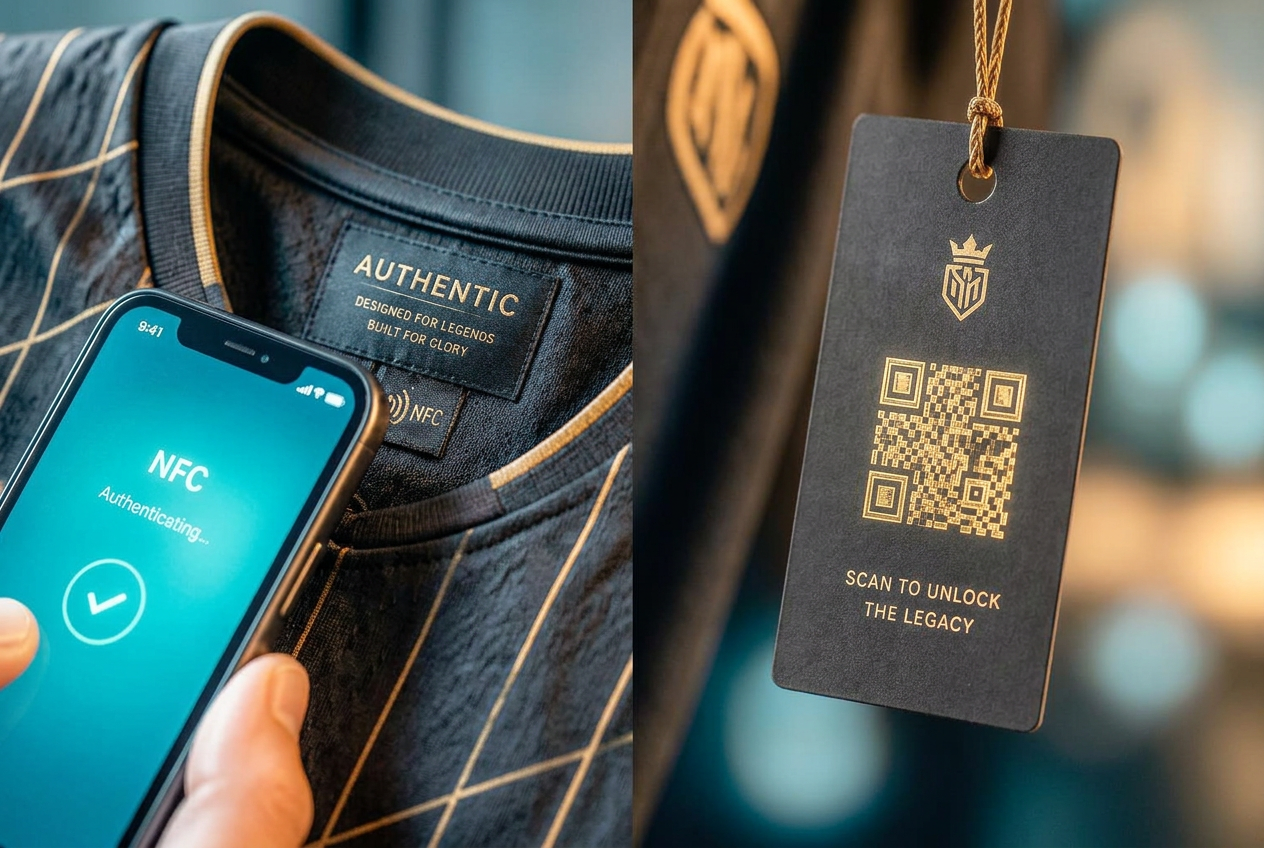
The first decision in any connected-merchandise programme is the same: NFC, QR, or both. The answer matters more than people think — it shapes per-unit cost, the kind of fan you can reach, what you can do to stop counterfeits, and what the on-product moment actually feels like.
The short version: NFC is the headline interaction. QR is the universal fallback. Serious programmes use both.
What each technology actually is
QR codes are printed two-dimensional barcodes. Any smartphone camera reads them. They cost nothing to add — they're ink. They cannot be updated after print, and one code is identical to every other copy of itself unless you serialise.
NFC is a wireless protocol. A passive chip embedded in a product is powered by the phone's field on tap, and transmits a payload — typically a URL — across a centimetre or two. Every chip is uniquely serialised at manufacture. Chips like the NTAG 424 DNA add cryptographic signing, so every tap is unforgeable.
The five dimensions that matter
1. Speed of interaction
NFC: tap, page opens, under a second. QR: open camera, frame the code, wait for the OS to recognise, tap the banner, page opens — two to five seconds in good conditions, longer in dim light or with reflective packaging.
For a fan in their seat at a stadium with a phone already in their hand: NFC wins. For a fan looking at a print ad on the Underground: QR is the only option.
2. Per-unit cost
QR is free — it's an ink change on packaging or a label. NFC adds chip cost (typically a few cents to a few tens of cents per unit, depending on chip family and format) plus the cost of integrating the chip into the product. For high-volume basics this matters. For premium drops, scarves, vinyl, or tickets, it doesn't.
3. Counterfeit resistance
A static QR can be photographed and reprinted infinitely. A dynamic QR (with a one-time signed URL) is better, but the URL is still copyable. An NTAG 424 DNA chip signs every tap on-device with a key the counterfeiter cannot extract. Genuinely counterfeit-resistant programmes use NFC for this reason.
4. Where it lives on the product
QR is visible by definition. That's good for discovery and bad for design. NFC is invisible — woven into a label, hidden inside a patch, embedded under a leather inlay. For luxury, premium sport, and music merchandise where the product is the brand, NFC's invisibility is worth the chip cost on its own.
5. Fan demographics
Every iPhone since the iPhone XS (2018) and every modern Android reads NFC natively. That is well over 95% of smartphones in active use in mature markets. QR added camera-native reading on iOS in 2017. Today, both work for nearly everyone — but the fan has to know QR is an option, and they have to do something with the camera. NFC is just "tap the thing."
How to think about the choice
The decision rarely splits cleanly. The pattern that works:
- NFC as the primary, on-product interaction. The chip lives inside the product (woven label, hidden patch, ticket lamination). It carries the fan into the premium moment.
- QR as the visible fallback and external surface. Printed on the hangtag, the packaging, the print ad, the social post. Fans who can't tap can still scan.
- Same destination URL on both. The resolver doesn't care how the fan arrived. The experience is identical.
This is how every well-run programme on the Fan Connect platform is built. NFC for the premium tap. QR for the long tail. One identity behind both.
When to skip NFC
There are real cases where QR is the right answer on its own: very low per-unit cost targets (basic tees at scale), pure print/out-of-home campaigns with no physical product, and pilots where you need to test resonance before committing to chip integration in a supply chain. In all three, QR-only is a perfectly sound first step.
The bottom line
NFC is the experience. QR is the safety net. Treat them as complements, not alternatives, and the decision stops being a debate and starts being a spec.